

Blog
Normal Period Pain vs Warning Signs: When to Worry

Quick answer: Normal period pain starts on day one, peaks in the first 24 to 48 hours and eases by day three. Pain is not normal if it gets worse every month, lasts more than three days, stops you working or studying, does not respond to heat, or comes with very heavy bleeding, pain during intimacy or bleeding between periods.
DRAP Approved
Cash on Delivery
Nationwide Delivery
Medical author for Remedial Nexus. Published:
Table of Contents
- What normal period pain looks like
- 8 warning signs to take seriously
- Conditions behind unusual pain
- Normal vs warning: side by side
- What to do if you are unsure
- What happens at the doctor
- Frequently asked questions (Urdu & English)
- References
What normal period pain looks like
Before we talk about warning signs, let me describe what ordinary period pain usually looks like. Many women worry unnecessarily because nobody has ever told them what is normal.
Normal period pain (primary dysmenorrhea) has a very clear pattern: it starts on the first day of bleeding, peaks in the first 24–48 hours, and eases by the third day. It responds to heat, rest and simple measures.[1]
8 warning signs to take seriously
These are the signs I ask every patient about. If you recognise one or more, please book an appointment rather than waiting another month.
Conditions behind unusual pain
When period pain does not follow the normal pattern, one of these conditions is often the reason. The good news is that all of them are more manageable when found early.
| Condition | Typical clues | Quick note |
|---|---|---|
| Endometriosis | Severe pain, pain during intimacy, pain with bowel movements, infertility | Tissue like the womb lining grows outside the womb |
| Fibroids | Very heavy periods, large clots, pressure or swelling in the belly | Non-cancerous growths in the womb wall |
| Adenomyosis | Heavy, painful periods that worsen with age, enlarged womb | Womb lining grows into the womb muscle |
| PCOS | Irregular or missed periods, acne, excess hair, weight gain | Hormonal and metabolic condition |
| Pelvic infection | Pain with fever, unusual discharge, pain during intimacy | Needs prompt treatment |
| Thyroid problems | Heavy or irregular periods, tiredness, weight change | Checked with a simple blood test |
| Copper IUD effect | Heavier and more painful periods after fitting | Often settles, but worth reviewing |
Normal vs warning: side by side
| Feature | Normal period pain | Warning sign |
|---|---|---|
| When it starts | Day 1 of bleeding | Before the period, or mid-cycle |
| How long | 1–3 days | More than 3 days |
| Pattern over months | Stable or improving | Worsening every month |
| Response to heat | Clearly better | Little or no improvement |
| Effect on life | Manageable with self-care | Stops work, study or sleep |
| Bleeding | Normal flow | Soaking a pad in 1–2 hours |
| Pain during intimacy | None | Present |
| Bleeding between periods | None | Present |
| Fever | None | Possible |
What to do if you are unsure
- Track for two cycles. Write down dates, pain levels (1–10), pad use and what helped. Patterns become obvious quickly.
- Compare against the normal pattern. Day 1 start, peak in 24–48 hours, ease by day 3. If yours differs, note how.
- Try the basic measures first. Heat, movement, hydration, magnesium-rich food and less caffeine. If they clearly help, that is reassuring.
- Book an appointment if any warning sign is present. You do not need several signs — one is enough.
- Take your notes with you. This makes the consultation faster and more useful.
- Ask directly: could this be endometriosis, fibroids or PCOS? It is a fair question and a good doctor will answer it.
Support, not a substitute
Nutritional support such as OvaNorm can help ordinary cycle comfort, but it does not diagnose or treat endometriosis, fibroids or PCOS. If your pain fits any warning sign above, see a doctor first. Supplements work alongside medical care — never instead of it.
What happens at the doctor
Many women delay because they fear an embarrassing or painful examination. In reality, the first visit is usually simple and mostly a conversation.
1. Your history
The doctor asks about your cycle, the pain pattern, bleeding and family history. Your notes are very useful here. This is the most important part of the visit.
2. An examination
A gentle abdominal examination is usually done. An internal examination is only done if needed and you can always ask for a female doctor or a chaperone.
3. Tests if needed
An ultrasound scan, blood tests or, in some cases, a referral to a specialist. Endometriosis sometimes needs a scan or a minor procedure to confirm.
You are allowed to ask questions, ask for a female doctor, and ask for a chaperone. A good doctor will always respect that.
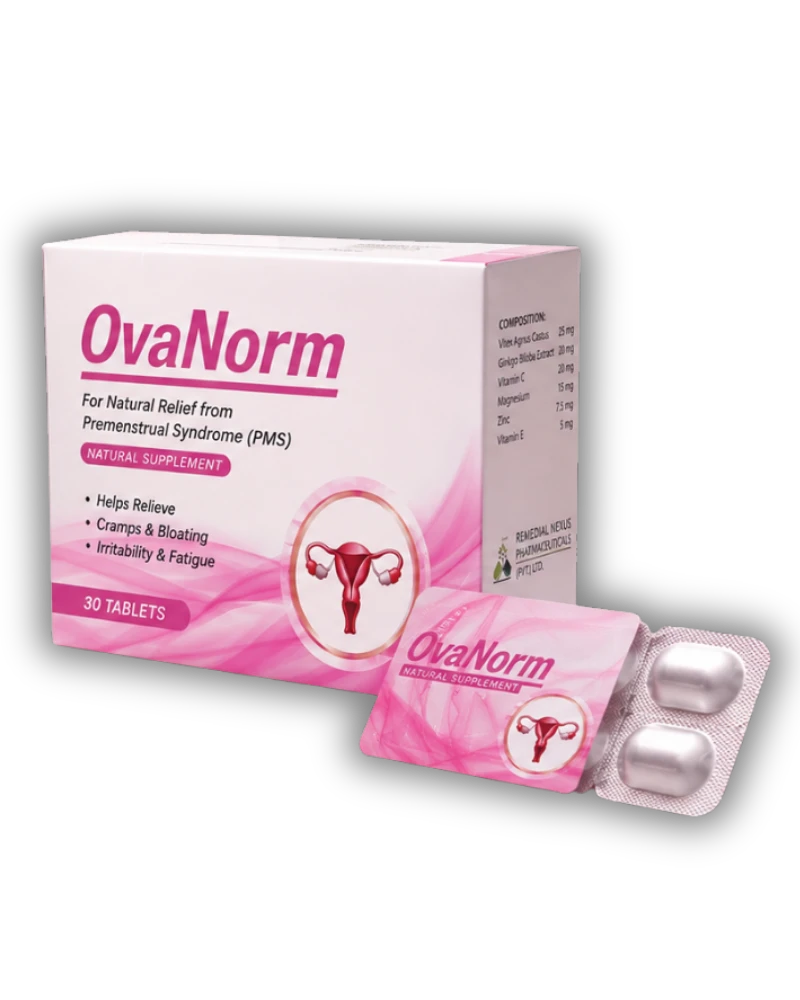
OvaNorm
A daily nutritional supplement formulated with Vitex, Magnesium, Calcium, Zinc, Vitamin C and Ginkgo Biloba to support hormonal balance and comfort during your cycle.
Rs. 1,450 · Cash on delivery across Pakistan · Discreet packaging · 3–5 days
FDA and DRAP approved. It is a supplement, not a medicine. Speak to your doctor before starting.
Frequently asked questions
Kya period ka dard kabhi normal nahi hota? (Is period pain ever not normal?)
Dard jo har mahine barhta ja raha ho, teen din se zyada rahe, garam sekaai se kam na ho, ya kaam aur padhai rok de — yeh normal nahi. Aise dard ki wajah janchna zaroori hai.
How much period pain is too much?
There is no single number, but a useful rule is: if the pain regularly stops you from working, studying or sleeping, or if you need strong painkillers every month, it is too much and should be checked. Pain is a signal, not a test of endurance.
Kya shadeed dard endometriosis ki alamat hai? (Is severe pain a sign of endometriosis?)
Ho sakti hai. Endometriosis mein dard bohat tez hota hai, aur akasr intimate relations mein bhi takleef hoti hai. Lekin har shadeed dard endometriosis nahi hota — fibroids, adenomyosis aur infection bhi wajah ban sakte hain. Confirm karne ke liye doctor se milna zaroori hai.
Should I see a doctor if heat still helps?
If heat clearly helps, the pain is more likely to be ordinary primary period pain. But if the pain is worsening month by month, lasting more than three days, or affecting your life despite heat, still get it checked.
Can period pain mean I cannot have children?
Ordinary period pain does not affect fertility at all. However, some conditions that cause unusual pain — such as endometriosis or PCOS — can affect fertility if untreated. This is one more reason not to ignore pain that does not follow the normal pattern.
I feel embarrassed to see a male doctor. What can I do?
You have every right to ask for a female doctor, and to ask for a chaperone (a female attendant) to be present. In Pakistan, most hospitals and clinics have female doctors available. Your comfort matters and does not need to be a barrier to care.
References
- Mayo Clinic — Menstrual cramps
- NHS UK — Period pain
- NHS UK — Endometriosis
- PubMed — Secondary dysmenorrhea: causes
- American College of Obstetricians and Gynecologists — Dysmenorrhea: painful periods
- World Health Organization — Menstrual health
Medical disclaimer: This article is for general education only and is not medical advice. OvaNorm is a dietary supplement, not a medicine. It is not intended to diagnose, treat, cure or prevent any disease. Always consult a qualified doctor before starting any supplement, especially if you are pregnant, breastfeeding, under 18, or taking other medication. Individual results vary.
