

Blog
Period Pain in Pakistan: Why So Many Women Suffer in Silence

Quick answer: Period pain is very common in Pakistan, but it is often treated as something women must simply bear. Cultural silence, limited access to women doctors, and the belief that pain is normal all delay help. In most cases, simple steps such as heat, magnesium-rich food, light movement and better sleep reduce the pain a great deal.
DRAP Approved
Cash on Delivery
Nationwide Delivery
Medical author for Remedial Nexus. Published:
Table of Contents
- How common is period pain in Pakistan?
- Four reasons women stay silent
- What it costs women every month
- What can actually be done
- When to see a doctor
- Frequently asked questions (Urdu & English)
- References
How common is period pain in Pakistan?
In my clinic, I have lost count of how many times a woman has sat down and said, almost apologetically, "Doctor, it is normal for me. I just bear it."
Period pain — medically called dysmenorrhea (dis-men-or-ee-ah) — affects a very large share of women of reproductive age. Studies from around the world suggest that up to 8 in 10 young women experience some pain with their periods, and roughly 1 in 5 describe it as severe enough to interfere with daily life.[1]
Pakistan is no different. What is different is how little it gets discussed.
Four reasons women stay silent
The pain itself is only part of the problem. In my years of practice, I have noticed four barriers that keep women from getting help.
1. It is a "private" matter
Many girls are told not to discuss periods at all — not with their mother, not with a teacher, and certainly not with a male doctor. So pain goes unreported for years.
2. "Yeh to sab ko hota hai"
Because nearly every woman in the family has painful periods, it is accepted as normal. Common is not the same as normal.
3. No rest is possible
Women still cook, work, study and travel during their period. The pain costs days of productive life every single month.
4. Fear of being judged
Some women worry that talking about period problems will lead to questions about marriage, fertility or "family matters" they would rather avoid.
5. Cost and distance
A specialist appointment, travel and time away from work are real barriers for many families, especially outside the big cities.
6. Normalising by painkillers
Many women self-treat with painkillers every month without ever learning why the pain is strong, or whether something else is causing it.
What it costs women every month
Period pain is not just discomfort. It has a measurable cost in school days, work days and quality of life.
| Area of life | How period pain affects it | Typical pattern |
|---|---|---|
| School and college | Missed classes, difficulty concentrating in exams | 1–3 days per month |
| Work | Reduced output, sick leave, difficulty standing for long hours | 1–2 days per month |
| Household duties | Cooking, cleaning and caring continue regardless | Pain not rested through |
| Sleep | Broken sleep, tiredness the following day | Often 1–2 nights |
| Mood and relationships | Irritability, low mood, withdrawal | Several days per cycle |
| Long-term health | Untreated causes such as endometriosis progress | Gets worse over years |
What can actually be done
The good news is that most ordinary period pain responds well to simple, low-cost measures. These are the steps I usually discuss with patients.
- Start heat early. A hot water bottle or warm cloth on the lower belly for 20–30 minutes relaxes the muscle and improves blood flow. Research shows it can work as well as a mild painkiller for many women.[2] Start it on day one, before the pain peaks.
- Walk, do not lie still. Fifteen minutes of slow walking, stretching or gentle yoga reduces cramps, because movement improves blood flow and releases the body’s own pain-relieving chemicals.
- Eat magnesium-rich food. Spinach, sarson saag, almonds, peanuts, banana and whole wheat roti all help muscles relax. Magnesium has been studied for both period pain and PMS.[3]
- Drink 8–10 glasses of water. Dehydration makes cramps stronger, and in Pakistani weather this is easy to miss.
- Cut back on strong chai and sugary drinks. Too much caffeine and sugar increases tension and bloating. Four to five cups a day is common here, and it works against you.
- Protect your sleep. Poor sleep makes the brain more sensitive to pain. A regular sleep time makes a real difference over one to two cycles.
- Consider nutritional support. Minerals and plant extracts such as magnesium, calcium, zinc, vitamin C and Vitex are used to support hormonal balance and muscle comfort. These support normal function — they do not replace medical care.
What to eat during your period
| Goal | Eat more | Limit |
|---|---|---|
| Relax muscles (magnesium) | Spinach, sarson saag, almonds, peanuts, banana, whole wheat roti | — |
| Reduce tiredness (iron) | Liver, beef, chana, masoor dal, dates | Tea with meals (blocks iron) |
| Steady mood (calcium) | Doodh, dahi, lassi, small fish | — |
| Reduce bloating | Water, cucumber, melon, plain rice, ginger tea | Very salty food, cold drinks, excess chai |
| Reduce pain | Ginger, turmeric in food, walnuts | Deep-fried snacks, too much sugar |
When to see a doctor
Please book an appointment if you notice any of these. They can be signs of a condition that is very treatable when found early.
These can point to endometriosis, fibroids, PCOS or an infection — all of which are far easier to manage when they are found early.
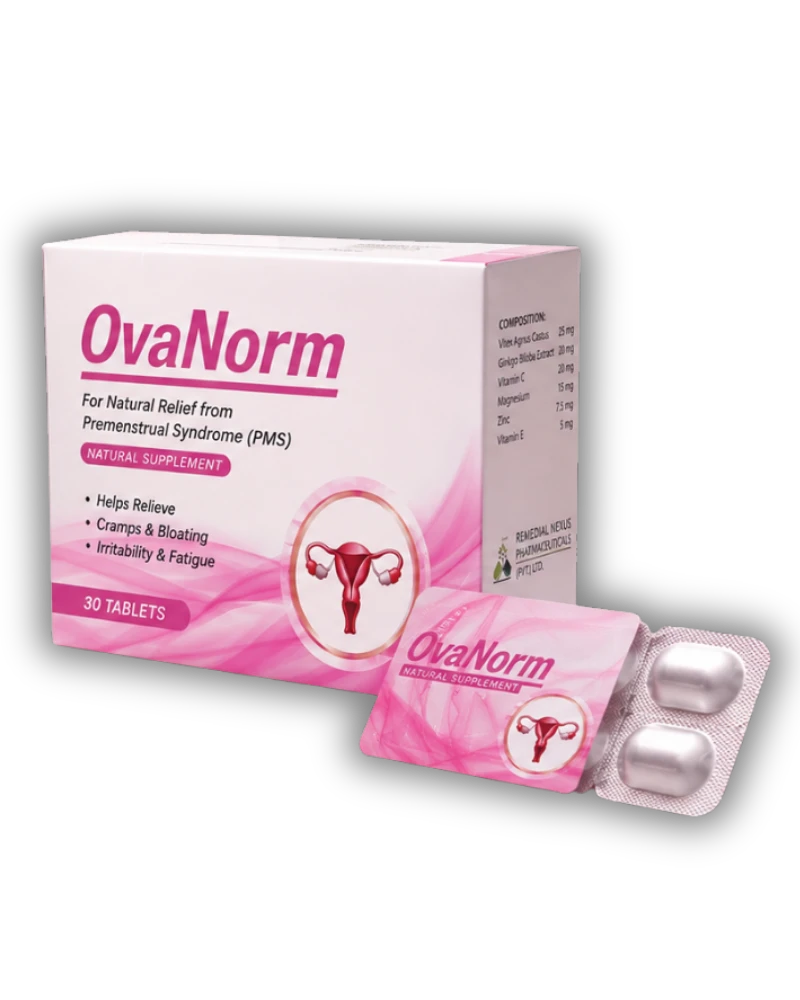
OvaNorm
A daily nutritional supplement formulated with Vitex, Magnesium, Calcium, Zinc, Vitamin C and Ginkgo Biloba to support hormonal balance and muscle comfort during your cycle.
Rs. 1,450 · Cash on delivery across Pakistan · Discreet packaging · 3–5 days
FDA and DRAP approved. It is a supplement, not a medicine. Speak to your doctor before starting.
Frequently asked questions
Pakistan mein mahwari ke dard kitna aam hai? (How common is period pain in Pakistan?)
Bohat aam hai. Takreeban 8 mein se 8 khatoon ko kisi na kisi had tak dard hota hai, aur 5 mein se 1 ko itna dard hota hai ke school ya kaam chhoot jata hai. Lekin Pakistan mein is par baat kam hoti hai, is liye zyada tar khatoon khamoshi se bardasht karti hain.
Is period pain a sign of infertility?
Not by itself. Ordinary period pain does not affect fertility. However, some conditions that cause severe period pain — such as endometriosis or PCOS — can affect fertility if they are not managed. This is one more reason to get strong, worsening pain properly checked.
Dard kam karne ka sab se asaan tarika kya hai? (What is the easiest way to reduce the pain?)
Garam paani ki bottle se pait par sekaai, halki walk, paani zyada peena, aur magnesium wali khuraak (palak, badam, kela). Chai aur cold drinks kam karein. Yeh sab ghar par mumkin hain aur koi kharcha nahi.
Should I take painkillers every month?
Occasional use of simple painkillers is usually safe for most healthy women, but regular monthly use without guidance is not ideal. If you need them every month, it is better to find out why your pain is strong. Speak to a doctor or pharmacist about the right dose and timing.
Can a supplement replace a doctor’s treatment?
No. Supplements support normal body functions — they do not diagnose or treat disease. They work best alongside good food, rest and medical advice. If your pain is severe or getting worse, see a doctor first.
How long before I notice a difference?
Most women notice a clear improvement after one to two cycles of consistent changes. Nutritional supplements are usually used for around two to three months. Everyone is different, so results vary.
References
- World Health Organization — Menstrual health
- NHS UK — Period pain
- PubMed — Magnesium and primary dysmenorrhea studies
- Mayo Clinic — Menstrual cramps
- American College of Obstetricians and Gynecologists — Dysmenorrhea: painful periods
- Cochrane Library — Non-surgical interventions for period pain
Medical disclaimer: This article is for general education only and is not medical advice. OvaNorm is a dietary supplement, not a medicine. It is not intended to diagnose, treat, cure or prevent any disease. Always consult a qualified doctor before starting any supplement, especially if you are pregnant, breastfeeding, under 18, or taking other medication. Individual results vary.
