

Blog
Why Are My Periods So Painful? Dysmenorrhea Explained Simply

Quick answer: Periods hurt because the womb releases chemicals called prostaglandins that make its muscles tighten strongly. When levels are high, the tightening briefly cuts blood flow to the muscle, which is felt as a cramp. Pain that is severe, getting worse or lasts more than 3 days may have another cause and should be checked by a doctor.
Medical author for Remedial Nexus. Published:
Table of Contents
- The short answer
- How much pain is normal?
- What is happening inside your body
- 8 reasons your periods are so painful
- Why this is a bigger problem in Pakistan
- What you can do this month
- Home care vs medicine vs support
- When to see a doctor
- Frequently asked questions (Urdu & English)
- References
The short answer
If you are asking “why are my periods so painful?”, you are not alone. Period pain — doctors call it dysmenorrhea (dis-men-or-ee-ah) — is one of the most common health complaints among women of every age.
In my clinic in Pakistan, I hear this question several times a week. And almost always, the woman asking it has been told the same thing for years: “It is normal. Just bear it.”
That advice is wrong. Common pain is not the same as normal pain. There is a real, physical reason for what you feel — and in most cases, there is something you can do about it.
How much pain is normal?
Before we go further, let us define “normal”. This is important, because many women wait years before asking for help — usually because they think their pain is ordinary.
| Symptom | Usually normal | Worth checking |
|---|---|---|
| When it starts | 1–2 days before bleeding | More than 3 days before |
| How long it lasts | 1–3 days | 4 days or more |
| Type of pain | Dull, cramping, comes in waves | Sharp, stabbing, constant |
| Effect on life | Mild discomfort; you can work | You miss school, work or sleep |
| Over the years | Same or slightly better | Getting worse every year |
| Between periods | No pain | Pain outside your period days |
| Relief from heat | Helps noticeably | Does not help at all |
If most of your answers are in the middle column, you are in the range of ordinary period pain — and there is plenty you can do to make it milder. If several answers are in the right-hand column, please read the section on when to see a doctor.
What is happening inside your body
Here is the process in plain words.
Each month, your womb (uterus) builds up a lining to prepare for a possible pregnancy. If pregnancy does not happen, that lining has to leave the body — that is your period. To push the lining out, the muscles of the womb contract (tighten and relax).
These contractions are triggered by chemicals called prostaglandins. Think of them as the body’s messenger for “time to squeeze”.
Here is the key point: the amount of prostaglandin your body makes decides how much pain you feel. Women with strong, frequent cramps usually produce more of it. This is also why some women get nausea, headache or loose motions during their period — prostaglandins affect the gut and blood vessels too.
8 reasons your periods are so painful
Painful periods fall into two groups. Primary dysmenorrhea means the pain is caused by prostaglandins alone — there is no underlying disease. Secondary dysmenorrhea means a condition is causing the pain. Here are the eight most common reasons I see.
1. High prostaglandins
The most common cause. Your body simply produces more of the pain-triggering chemical.
2. Endometriosis
Tissue like the womb lining grows outside the womb. Pain is often severe and gets worse over time.
3. Fibroids
Non-cancerous growths in the womb. They cause heavy bleeding and cramping.
4. PCOS
Hormone imbalance that causes irregular, heavy and painful periods. Very common in Pakistan.
5. Narrow or tilted womb
Some women are born with a womb shape that makes contractions more painful.
6. Infection (PID)
Pelvic infection causes ongoing pain, often with fever or unusual discharge. Needs treatment.
7. Low magnesium & calcium
These minerals help muscles relax. Low levels are linked to stronger cramps.
8. Stress and poor sleep
Long-term stress and little sleep make the body more sensitive to pain.
Why this is a bigger problem in Pakistan
In my years of practice, I have noticed four things that make period pain harder for women in Pakistan than it needs to be.
1. Silence around the topic
Many girls are taught that periods are a private matter that should not be discussed — not with their mother, not with a teacher, and certainly not with a male doctor. So the pain continues for years without anyone asking the right questions.
2. “Yeh to sab ko hota hai”
Because nearly every woman in the family has painful periods, the pain is accepted as a normal part of being a woman. This is the single most common reason women delay getting help.
3. No rest, even during the worst days
In many families, women are still expected to cook, clean, work and study during their period. So the pain is not just pain — it costs days of productive life every single month.
4. Heavy chai and low water intake
Chai is a part of daily life in Pakistan, and most people drink it four to five times a day. Too much caffeine can increase tension and bloating, while not drinking enough water makes cramps stronger. Both are easy to fix once you know.
What you can do this month
These are the steps I usually discuss with patients before considering anything stronger. They are simple, low-cost, and you can start today.
Heat — the most under-used remedy
A hot water bottle, warm cloth or heat patch on the lower belly for 20–30 minutes relaxes the muscle and improves blood flow. Research shows it can work as well as a mild painkiller for many women.[2] In Pakistan this is also the cheapest option — a bottle of hot water costs nothing.
Light movement
You do not need a gym. Walking slowly for 15 minutes, stretching, or gentle yoga reduces cramps because movement improves blood flow and releases the body’s own pain-relieving chemicals. Bed rest all day can actually make cramps feel worse.
Magnesium-rich food and water
Magnesium helps muscles relax. Studies show it can reduce both period pain and PMS symptoms.[3] Aim for 8–10 glasses of water a day — in hot Pakistani weather, dehydration is easy to miss and it makes cramps stronger.
Sleep and stress
Poor sleep and ongoing stress make the brain more sensitive to pain. Regular sleep timing and two minutes of slow breathing make a real difference over a couple of months.
Nutritional support
Some minerals and plant extracts — magnesium, calcium, zinc, vitamin C and Vitex — are used to support hormonal balance and muscle comfort. These are support options. They do not replace medical care, and you should speak to your doctor before starting any of them.
Home care vs medicine vs nutritional support
Women often ask me which option is best. The honest answer is that they do different jobs, and they can be used together.
| Approach | What it does | Best for | Things to know |
|---|---|---|---|
| Heat + rest + water | Relaxes the muscle, improves blood flow | Mild to moderate cramps | Safe, free, no side effects. Try first. |
| Diet & exercise | Reduces inflammation and muscle tension over time | Anyone, every month | Takes 1–2 cycles to show a clear difference. |
| Painkillers | Block prostaglandin production | Strong pain on day 1–2 | Effective, but should be used with correct dose and timing. Regular monthly use without guidance is not ideal. |
| Nutritional support | Supports normal hormone balance and muscle comfort | Ongoing monthly discomfort and PMS | A supplement, not a medicine. Often used for 2–3 months. Doctor’s advice first. |
| Doctor’s treatment | Treats the underlying cause | Severe, worsening or unusual pain | Essential if a condition such as endometriosis or PCOS is suspected. |
When to see a doctor
Please book an appointment if you notice any of these. They can be signs of a condition that is very treatable when found early.
A note on nutritional support
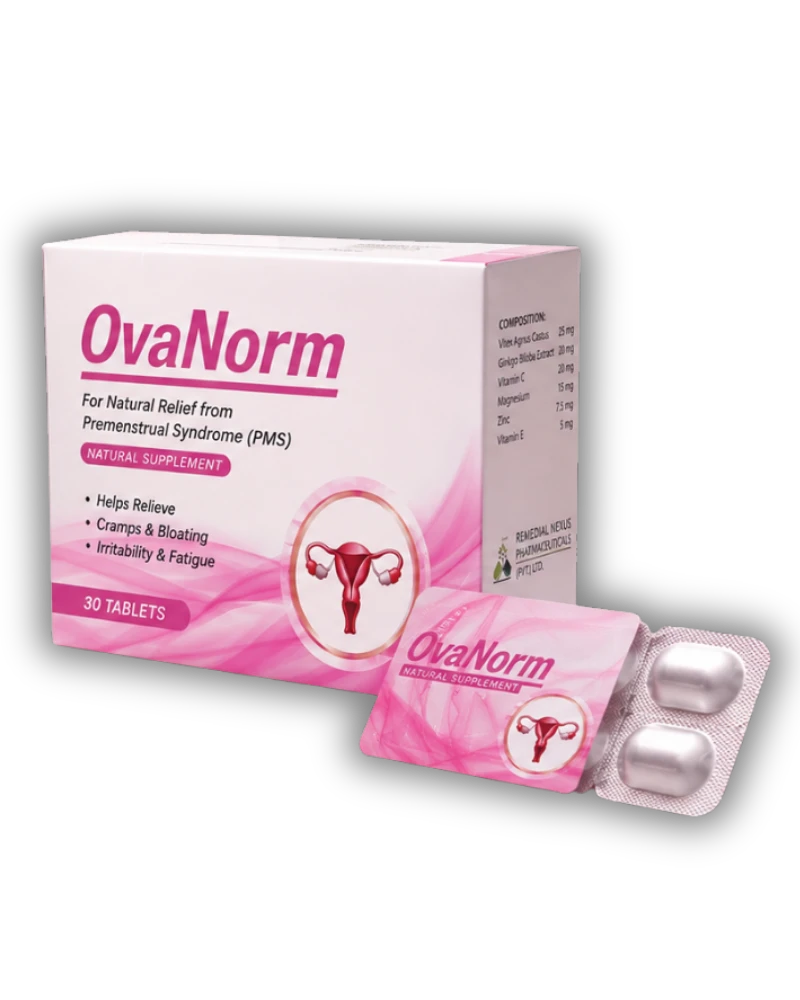
OvaNorm
A daily nutritional supplement formulated with Vitex, Magnesium, Calcium, Zinc, Vitamin C and Ginkgo Biloba to support hormonal balance and muscle comfort during your cycle.
Rs. 1,450 · Cash on delivery across Pakistan · Discreet packaging · 3–5 days
It is a supplement, not a medicine. Speak to your doctor before starting.
Frequently asked questions
Periods mein itna dard kyun hota hai? (Why is there so much pain during periods?)
Periods ke dauran womb mein prostaglandin naam ke chemicals bante hain. Yeh womb ki muscles ko kashte hain taake lining bahar nikle. Jab yeh chemicals zyada bante hain, to dard bhi zyada hota hai. Isi wajah se kuch khatoon ko matli ya loose motions bhi hoti hain.
Is it normal to have very painful periods every month?
It is common, but that does not make it normal. Pain that returns every month and stops you from studying, working or sleeping should be checked. In most women it can be reduced a lot with simple steps — and sometimes there is an underlying cause that needs treatment.
Dard kam karne ke liye ghar par kya karein? (What can I do at home to reduce the pain?)
Sab se pehle garam paani ki bottle se pait par 20–30 minute sekaai karein. Halki walk karein, 8–10 glass paani piyein, aur magnesium wali khuraak lein (palak, badam, kela, whole wheat roti). Chai aur cold drinks kam karein. Agar dard phir bhi bardasht se bahar ho, to doctor se milein.
Does what I eat really affect period pain?
Yes. A diet rich in magnesium, calcium and iron genuinely reduces cramping, bloating and tiredness over one to two cycles. The opposite is also true — very salty food, too much sugar and too much caffeine can make the symptoms worse.
Can period pain mean I cannot have children?
Not by itself. Ordinary period pain does not affect fertility. However, some conditions that cause severe period pain — such as endometriosis or PCOS — can affect fertility if they are not managed. This is another good reason to get strong, worsening pain properly checked.
How long before lifestyle changes make a difference?
Most women notice a clear improvement after one to two cycles. Nutritional supplements are usually used consistently for around two to three months. Everyone is different, so results vary.
References
- World Health Organization — Menstrual health
- NHS UK — Period pain
- PubMed — Magnesium and primary dysmenorrhea studies
- Mayo Clinic — Menstrual cramps
- American College of Obstetricians and Gynecologists — Dysmenorrhea: painful periods
- Cochrane Library — Non-surgical interventions for period pain
Medical disclaimer: This article is for general education only and is not medical advice. OvaNorm is a dietary supplement, not a medicine. It is not intended to diagnose, treat, cure or prevent any disease. Always consult a qualified doctor before starting any supplement, especially if you are pregnant, breastfeeding, under 18, or taking other medication. Individual results vary.
